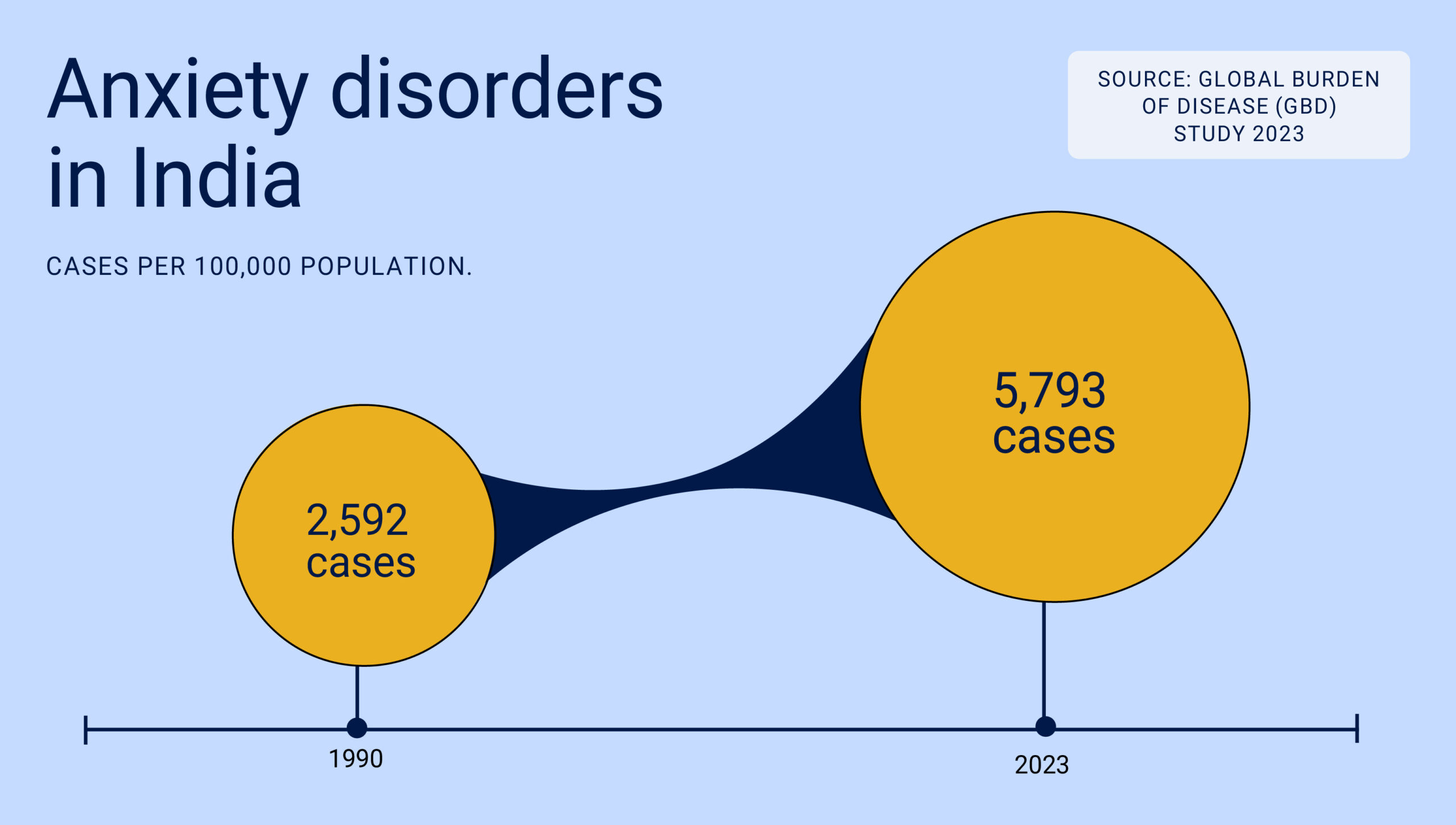
Summary: The latest Global Burden of Disease (GBD) Study 2023 reveals a growing burden of mental disorders in India and worldwide. Anxiety disorders in India have more than doubled since 1990, while depression and other mental disorders have also become more prevalent. Globally, mental disorders now affect one in seven people and are the leading cause of disability.
Mental disorders are becoming an increasingly important public health challenge in India. According to the latest Global Burden of Disease (GBD) Study 2023, the prevalence of anxiety disorders in India increased by 123.5% between 1990 and 2023. The study also found a rise in the prevalence of major depressive disorder, persistent depressive disorder (dysthymia) and schizophrenia, pointing to a growing need for accessible, quality mental healthcare across the country.
The study found that in India, between 1990 and 2023:
- Anxiety disorders increased by 123.5%, from approximately 2,592 to 5,793 cases per 100,000 population.
- Major depressive disorder increased from 2,147.1 to 2,799.6 cases per 100,000 population.
- Persistent depressive disorder (dysthymia) increased from 902.4 to 948.8 cases per 100,000 population.
- Schizophrenia increased slightly, from 316.3 to 321 cases per 100,000 population.
These findings come at a time when India continues to face a significant treatment gap. The National Mental Health Survey (2015–16) estimated that nearly 85% of people living with mental health conditions do not receive the care they need, underscoring the need to strengthen mental health systems and expand access to community-based care.
The India estimates are part of a larger global analysis published in The Lancet by the GBD 2023 Mental Disorder Collaborators, led the Institute for Health Metrics and Evaluation (IHME) at the University of Washington, Seattle (USA). Covering 204 countries and territories between 1990 and 2023, the study offers one of the most comprehensive assessments of the prevalence and burden of mental disorders to date. It shows that India's experience is part of a wider global trend: mental disorders are becoming more common and are now among the leading causes of ill health worldwide.
Mental disorders affect one in seven people globally
The study estimates that almost 1.2 billion people were living with a mental disorder in 2023, nearly one in seven people worldwide. Since 1990, the total number of people living with mental disorders has increased by 95.5%. Even after accounting for population growth and ageing, the age-standardised prevalence increased by 24.2%, suggesting that mental disorders are becoming more common rather than simply affecting larger populations.
Rather than focusing only on mortality, the study measures how mental disorders affect people's lives through Disability-Adjusted Life Years (DALYs), a metric that combines years of life lost with years lived with disability. Mental disorders accounted for 171 million DALYsin 2023, making them the fifth leading cause of health loss globally, compared with twelfth in 1990. They also became the leading cause of Years Lived with Disability (YLDs), accounting for 17.3% of all YLDs worldwide.
Anxiety and depression
Among the 12 mental disorders included in the study:
- Anxiety disorders ranked as the 11th leading cause of DALYs globally.
- Major depressive disorder ranked 15th.
- Together, anxiety and depression contributed the largest share of disability associated with mental disorders worldwide.
The authors also report that the prevalence of anxiety and depressive disorders increased substantially following the COVID-19 pandemic. They note that these trends may reflect both pandemic-related stress and longer-term structural factors, while acknowledging that improved awareness and recognition may also have contributed to increased reporting.
Adolescents and women experience a higher burden
Globally, the study identified important differences across age and sex.
By age:- The burden of mental disorders peaked among 15 to 19-year-olds, making adolescence a critical period for prevention, early identification and support.
Users can select their role as a service user, caregiver, or service provider, as well as the State in which they reside. Based on these selections, the app provides information tailored to their specific needs and legal context, including relevant authorities, procedures, and state-specific information.
Application templates for key procedures
- 620 million women were living with a mental disorder globally in 2023, compared with 552 million men.
- Women experienced higher rates of anxiety disorders and major depressive disorder.
- ADHD, conduct disorder and autism spectrum disorder were more common among males, particularly during adolescence.
The study also highlights a persistent global treatment gap, estimating that only around 9% of people living with anxiety or depression receive minimally adequate treatment, defined as appropriate medication together with support from a healthcare provider.
Where do we go from here?
The GBD 2023 study makes one thing clear: mental disorders are not a niche health issue. They are among the leading causes of disability worldwide and a growing public health challenge in India. Addressing this burden will require sustained investment in prevention, early intervention and community-based care alongside stronger health systems.
At the Centre for Mental Health Law & Policy (CMHLP), we work with communities and young people to develop and scale evidence-based, low-cost interventions that improve access to mental healthcare and strengthen suicide prevention efforts.
Some of our key initiatives include:
- Atmiyata, a community-led, evidence-based intervention to reduce the mental health and social care gap in communities.
- Outlive, a youth suicide prevention programme which addresses urban youth suicides in India by engaging young people aged 18-24, in particular youth with experiences related to suicide/self-harm, distress or mental health problems.
As new evidence continues to emerge, translating research into practical, community-based solutions will be essential to ensuring that more people can access quality mental healthcare when and where they need it.
Sources
- Santomauro D, Miller P, Shadid J et al. Updated trends in the global prevalence and burden of mental disorders, 1990–2023. a systematic analysis for the Global Burden of Disease Study 2023. The Lancet, 407, 2040-2064
- Gautham MS, Gururaj G, Varghese M, Benegal V, Rao GN, Kokane A, Chavan BS, Dalal PK, Ram D, Pathak K, Lenin Singh RK, Singh LK, Sharma P, Saha PK, Ramasubramanian C, Mehta RY, Shibukumar TM; NMHS Collaborators Group. The National Mental Health Survey of India (2016): Prevalence, socio-demographic correlates and treatment gap of mental morbidity. Int J Soc Psychiatry. 2020 Jun;66(4):361-372. doi: 10.1177/0020764020907941. Epub 2020 Mar 4. PMID: 32126902.
- Depression, anxiety crisis deepens in India: Lancet study shows cases surged 123% between 1990 and 2023, Indian Express
- The Lancet Sounds Alarm Over India’s Exploding Anxiety Crisis, Cases Surged 123% since 1990, Times Now
- Mental disorders are becoming more common in India. Between 1990 and 2023, the prevalence of anxiety disorders increased by 123.5%, while depression and other mental disorders also became more prevalent.
- Mental disorders affect one in seven people globally. An estimated 1.17 billion people were living with a mental disorder in 2023, making mental health a major global public health priority.
- Mental disorders are the leading cause of disability worldwide. They accounted for 17.3% of all Years Lived with Disability (YLDs) and became the fifth leading cause of overall health loss globally.
- Young people and women experience a disproportionate burden. The highest burden was among 15 to 19-year-olds, while women experienced higher rates of anxiety and depression than men.
- India continues to face a significant treatment gap. Nearly 85% of people living with mental health conditions do not receive the care they need, highlighting persistent barriers to accessing support.