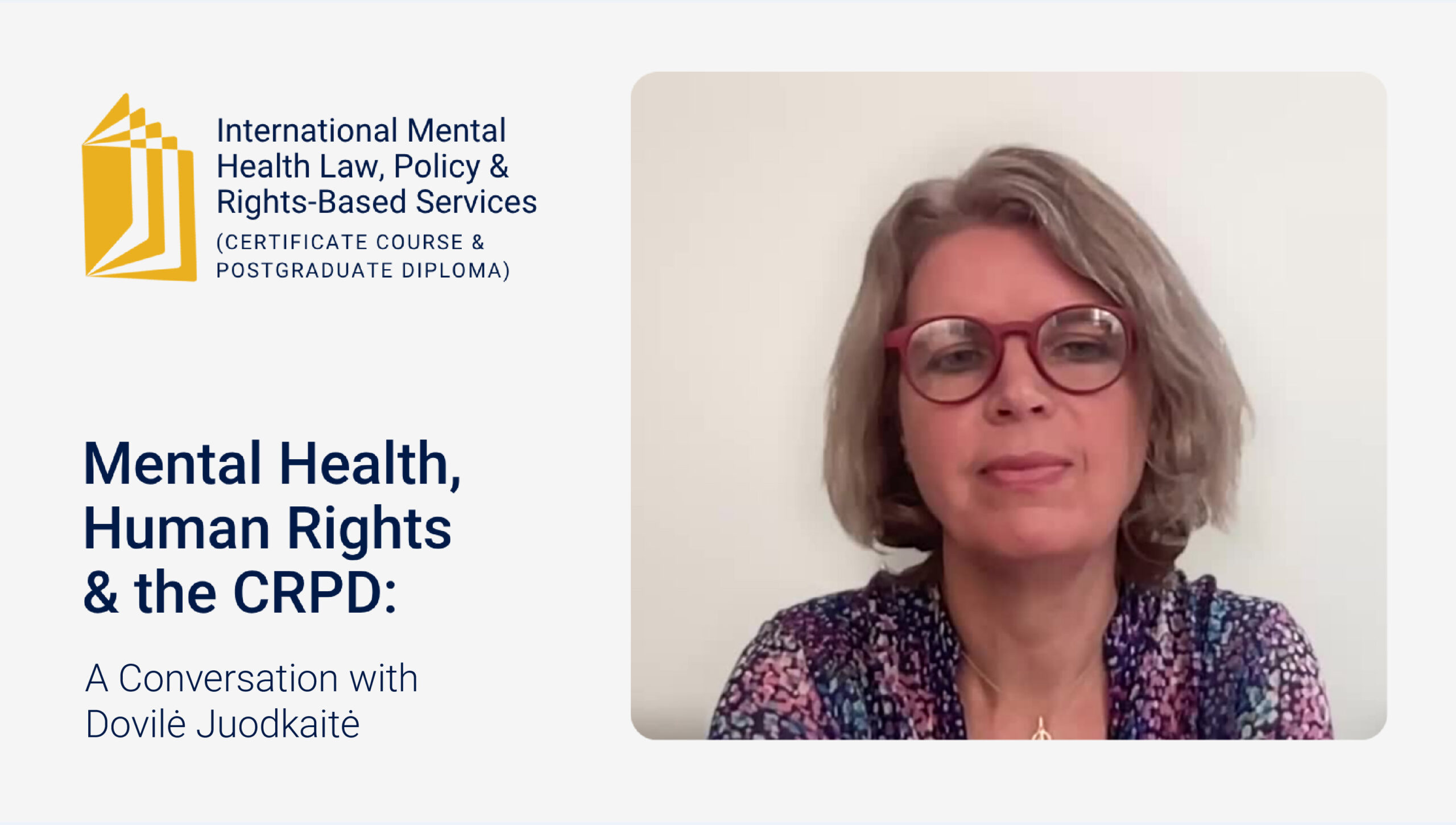
Summary: An interview with Dovilė Juodkaitė, elected member of the UN Committee on the Rights of Persons with Disabilities (2027–2030)
For Dovilė Juodkaitė, human rights advocacy has been a journey spanning more than two decades. A human rights lawyer, disability rights advocate and longstanding member of the CMHLP Learn community, Dovilė has worked alongside persons with disabilities and their organisations at national, regional and international levels.
She is also an alumna of the 2010–11 cohort of the International Diploma in Mental Health, Human Rights and Law, now known as the International Mental Health Law, Policy and Rights-Based Services Programme. More than a decade later, she continues to contribute to the programme as a faculty member, sharing her experience and expertise with learners from around the world.
In 2026, Dovilė reached another significant milestone: she was elected to the United Nations Committee on the Rights of Persons with Disabilities (UN CRPD) for the 2027–2030 term.
Nimisha Ajaikumar, Project Manager at CMHLP, spoke to Dovilė about what this appointment means to her, the role of rights-based approaches in mental health, what she took away from her time as a Diploma student, and why collaboration and persistence are essential to creating lasting change.
Congratulations on your election to the UN Committee on the Rights of Persons with Disabilities. What does this appointment mean to you, personally and professionally?
Thank you. It is a great honour to be elected to the CRPD Committee, but also a huge responsibility.
Personally, this appointment reflects more than two decades of my work in the NGO sector and with civil society, alongside persons with disabilities and their organisations. Throughout those 26 years, I have worked at national, regional and international levels.
Professionally, as a lawyer, I also see this as an important opportunity to contribute to the promotion of international human rights standards globally. The Convention on the Rights of Persons with Disabilities is a global human rights treaty, and I see this role as an opportunity to contribute to strengthening the rights, dignity and autonomy of persons with disabilities worldwide.
There is still a lot of neglect and many harmful practices, particularly concerning persons with psychosocial disabilities. So, while this is an honour, it also carries a great responsibility to continue working towards change.
You were part of one of the earliest batches of the diploma. What drew you to the programme, and what were your biggest takeaways?
I was a student in the 2010–11 batch. At that time, the CRPD had only recently been adopted in 2006 and had entered into force in 2008. We were at the beginning of trying to understand how to implement the Convention at both global and national levels.
At the time, I was already working with disability organisations in Lithuania and advocating for human rights and international human rights standards. The diploma brought together international human rights standards with mental health law and challenged outdated systems and practices.
For me, it was an important opportunity to strengthen both my knowledge and my practice.
I would say the biggest takeaway was the value of learning and sharing between participants and faculty. People came from different disciplines and different countries, and we had very open and frank discussions between lawyers, psychiatrists, social workers and, especially, people with lived experience.
Those conversations reinforced the need for change, the need for cooperation, and the need to include service users and professionals from different disciplines if we want to achieve meaningful change.
The programme is rooted in a rights-based approach to mental health. Why is this perspective particularly important today?
A rights-based approach is more important now than ever.
We see in many countries, a shrinking civic space, and increasing challenges to fundamental human rights. At the same time, we have seen progress in disability rights, with the CRPD being implemented in many places.
But the transformation brought by the CRPD, from understanding disability primarily from a medical perspective to recognising it as a human rights issue, requires constant commitment. It cannot be taken for granted.
This transformation is particularly important in recognising persons with psychosocial disabilities, as well as persons with other disabilities, first and foremost as rights holders: people with the right to autonomy, legal capacity and full participation in society.
Yet in many countries, people with disabilities, particularly people with psychosocial disabilities, still do not have the same legal status or enjoy the same rights as other members of society.
We need to continue ensuring that people with lived experience are at the centre of decisions that affect their lives. Strengthening the human rights perspective means strengthening respect for dignity, equality and human rights for everyone, regardless of disability or other differences.
Society is diverse. In many ways, how society treats persons with disabilities is also a measure of how it protects human rights for everyone.
What gives you hope for the future of disability rights and mental health globally?
What gives me hope is the new generation. A new generation of professionals and specialists, and especially the growing global community of advocates and organisations committed to human rights.
We see and hear more people with lived experience raising their voices and sharing their experiences. This is crucial for legal and practical change.
There is also an important contribution from organisations such as the World Health Organization (WHO) in developing resources, but what is particularly important is the meaningful involvement of persons with disabilities in transformation and reform. Without them, and without dialogue across professional disciplines and with people with disabilities themselves, we cannot achieve real legal and policy change.
What advice would you give to current and future students who hope to create change in their communities and countries?
When I was a student, one of the most valuable parts of the programme was meeting other advocates and like-minded people working with people with disabilities and trying to change services and practices in their own countries and globally.
My advice is to stay connected.
Stay connected with the people you work with, with experts, with experts by experience, and with the networks you build. You will meet professionals from different countries and contexts and from different disciplines. Stay connected and work together for meaningful change.
I would also say: be patient and persistent.
Human rights reform and changes in practice do not happen very quickly. They take time, patience and persistence. But every step forward matters.
I see this from my own experience of advocacy in Lithuania. We still face many challenges in both the legal framework and practical services for people with psychosocial disabilities. But step by step, we are seeing progress and changes, both in law and in practice.
The diploma provides a huge amount of knowledge, practical tools and, importantly, a global network of committed professionals. Its real value lies in putting that knowledge and those connections into practice, going back home and using what you have learned, drawing on your networks and working collaboratively to change attitudes, narratives and practices.
Even small changes in a community or service matter. All change requires persistence and patience from advocates. So I would encourage students to take full advantage of the programme and then go beyond it, to continue putting the values, knowledge and connections they gain into practice.
Building knowledge, networks and action for rights-based change
Dovilė’s journey from student to faculty member and now elected member of the UN Committee on the Rights of Persons with Disabilities is a powerful example of how learning can become a foundation for long-term advocacy and change.
The International Mental Health Law, Policy and Rights-Based Services Programme builds on this legacy. The programme is grounded in the principles of the UNCRPD and brings together mental health, human rights, law, policy and rights-based services.
The programme offers two pathways:
Certificate Course: A 12-week online programme covering foundational concepts in mental health, human rights, law, policy and rights-based services.
Postgraduate Diploma: Building on the Certificate curriculum, the one-year Diploma includes advanced coursework, supervision, assessments and a residential programme in Pune, India
With international faculty, participants from diverse professional and lived-experience backgrounds, and a strong emphasis on learning across disciplines and contexts, the programme aims to create a global community committed to rights-based change.