
Summary: India's 2026 Transgender Amendment Act marks a significant shift from self-identification to medical certification as the basis for legal gender recognition. While much of the discussion has focused on legal rights, the amendment also raises important mental health considerations. Recognition, autonomy, dignity, and social inclusion are key determinants of wellbeing. Research shows that stigma, discrimination, and barriers to recognition can contribute to psychological distress among transgender people. The Act therefore highlights an important question: how can laws and policies support not only legal recognition, but also the conditions that enable people to live, participate, and thrive with dignity?
In May 2026, Transgender Persons (Protection of Rights) Amendment Act, 2026 officially came into force, bringing significant changes to India's transgender rights framework. Among the most debated provisions are the removal of self-identification as the basis for legal recognition and the introduction of a medical certification process for obtaining identity documents.
The Act has sparked widespread concern among transgender communities, legal experts, and human rights advocates, many of whom argue that it departs from the principles established by the Supreme Court in the landmark NALSA judgment of 2014.
While much of the public debate has focused on legal rights and constitutional protections, the implications for mental health deserve equal attention.
This blog examines the proposed changes through a mental health and human rights lens.
The Right to Self-Identify: What Changed?
According to the Census 2011, India officially recorded over 4.87 lakh individuals under the "others" or transgender category. This includes trans-person with intersex variations, gender-queer and people having such socio-cultural identities as kinnar, hijra, aaravani and jogta.
NALSA and the Principle of Self-Determination
In 2014, the Supreme Court of India, in National Legal Services Authority (NALSA) v. Union of India, recognised transgender persons' right to self-identify their gender. The Court held that self-determination of gender identity is intrinsic to personal autonomy, dignity, and freedom.
This principle informed the Transgender Persons (Protection of Rights) Act, 2019, which recognised a person's right to self-perceived gender identity.
What the 2026 Amendment Changes
The Amendment Act replaces self-identification with a certification process involving government-appointed medical boards and administrative approval. It also narrows the definition of who qualifies as a transgender person under the law and excludes self-perceived identities from legal recognition.
Understanding the Changes: 2019 Act vs 2026 Amendment
| Issue | Transgender Persons Act, 2019 | 2026 Amendment Act | Why It Matters |
|---|---|---|---|
| Right to Self-Identify | Allowed individuals to self-identify their gender and obtain a certificate via affidavit. | Replaced by mandatory medical examination via a District Medical Board headed by a Chief Medical Officer. | Shifts authority from self-identification to external verification. |
| Legal Definition | Covered trans men, trans women, non-binary, genderqueer, and socio-cultural identities. | Limited almost exclusively to specific socio-cultural groups (e.g., hijras, kinnars), five specific intersex variations, or those forced into the identity. | May affect who can access legal recognition. |
| Gender Fluidity | Recognized and implicitly protected non-binary and varied gender expressions. | Specifically excludes individuals with self-perceived or gender-fluid identities outside rigid physical/cultural criteria. | Raises questions about autonomy and self-determination. |
| Penalties & Offences | Lighter penalties for offences against trans persons (e.g., forced labour, denying public access). | Introduces a distinct category to address the "coerced" assumption of transgender identity, adding heavier penalties and stricter clauses for kidnapping or coercing an individual to assume a transgender identity. | Broadens the law's focus from punishing violence and discrimination against transgender persons to regulating coercion around gender identity itself. |
| Access to Documentation | Identity documents updated after issuance of certificate. | Documentation changes tied to new certification process. | Recognition process affects access to official documents. |
| Role of the State | Facilitates recognition of declared identity. | Verifies and certifies identity through designated mechanisms. | Represents a shift in how identity is recognised under law. |
| Mental Health Perspective | Greater emphasis on self-identification and autonomy. | Greater emphasis on verification and certification. | Recognition, autonomy, dignity, and inclusion are important determinants of mental wellbeing. |
Why Recognition Matters for Mental Health
Recognition matters because it affects:
- A person's sense of identity and dignity
- Access to education, employment and equal opportunities
- Healthcare access
- Social participation
- Safety in public spaces
- Experiences of discrimination
When identity is questioned, denied, or subjected to external validation, the psychological consequences can be significant.
Minority Stress: Understanding the Mental Health Impact
One useful framework for understanding these effects is the Minority Stress Theory.
The theory suggests that people from marginalised groups experience chronic stress arising from:
- Stigma
- Discrimination
- Anticipation of rejection
- Concealment of identity
- Internalised prejudice
These experiences are associated with higher rates of anxiety, depression, psychological distress, and suicidal ideation.
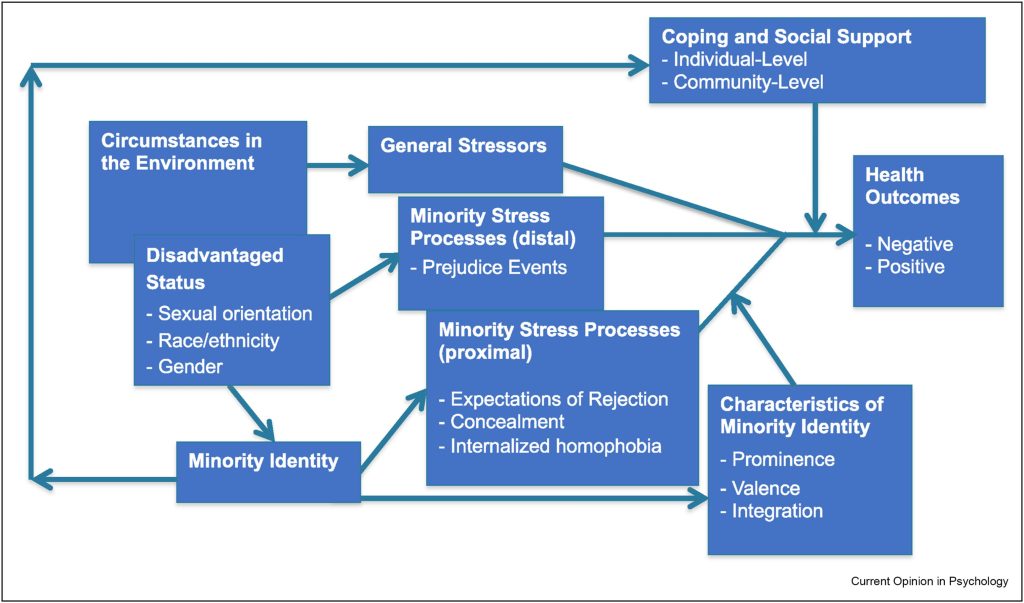
The minority stress model (Meyer, 2003)
For transgender people, legal systems can either reduce these stressors or intensify them.
When legal recognition becomes contingent upon medical approval, it may create additional barriers and uncertainty that contribute to psychological distress.
Mental Health Is Also About Autonomy
Mental health is closely linked to autonomy, the ability to make decisions about one's own life and identity. The World Health Organization increasingly recognises autonomy, participation, and dignity as essential components of wellbeing. A rights-based approach to mental health emphasises that people should be active agents in decisions affecting their lives rather than passive subjects of institutional control. This principle is reflected in international human rights frameworks, including the UN Convention on the Rights of Persons with Disabilities (CRPD), which India has ratified.
The debate around the Transgender Amendment Act is therefore not only about legal procedures. It is also about who has the authority to define identity.
Beyond Individual Distress: The Social Determinants of Mental Health
Social determinants of health are the non-medical conditions in which people are born, grow, live, work, and age. These factors, which include economic stability, education, neighbourhood environment, and social support, have a profound influence on overall health outcomes, quality of life, and health risks.
For example, studies by India's National Human Rights Commission (NHRC) reveal that an overwhelming 96% of transgender individuals face employment discrimination, while nearly half never attend school due to bullying and social exclusion. Here are some more findings:
- Education: In India, there is a high dropout rate among transgender individuals, driven largely by non-inclusive school environments and severe bullying. Literacy rates for the community lag significantly behind the national average.
- Employment: Despite meeting eligibility requirements, the vast majority of trans people are denied formal jobs and are pushed into informal, low-paying, or unsafe labour.
- Healthcare: Barriers in healthcare include the denial of care, lack of sensitivity from medical staff, and inaccessibility of gender-affirming procedures.
- Housing: Trans persons are frequently denied rentals or face harassment from landlords and neighbours, often leading to displacement or ghettoization.
Legal recognition influences all of these factors. When recognition becomes more difficult to obtain, the effects may extend far beyond documentation alone.
What Mental Health Professionals Are Saying
Mental health professionals and transgender advocates have expressed concerns that the Amendment Act may increase uncertainty and distress among transgender individuals.
Community protests across India have highlighted fears that many transgender persons may lose legal recognition or face additional barriers in accessing rights and services. According to a recent statement by public health professionals, many practitioners fear that the ambiguous wording and strict legal consequences of the Act will cause doctors and therapists to suspend gender-affirming and supportive services.
A Rights-Based Mental Health Perspective
From a rights-based perspective, mental health is not simply the absence of illness.
It is shaped by:
- Dignity
- Autonomy
- Participation
- Freedom from discrimination
- Social inclusion
- Policies affecting identity and recognition therefore have mental health implications, whether or not they are explicitly framed as mental health policies. As India continues to shape its transgender rights framework, policymakers, mental health professionals, and civil society must recognise that the question is not simply whether a person can obtain a certificate. It is whether they can live, participate, and thrive with dignity.
Sources
- NALSA v. Union of India (2014)
- The Transgender Persons (Protection of Rights) Act, 2019
- The Transgender Persons (Protection of Rights) Amendment Bill, 2026
- de Vries JMA, Downes C, Sharek D, Doyle L, Murphy R, Begley T, et al. An exploration of mental distress in transgender people in Ireland with reference to minority stress and dissonance theory. Int J Transgend Health. 2023;24(4):469–86. https://doi.org/10.1080/26895269.2022.2105772
- David M. Frost, Ilan H. Meyer, Minority stress theory: Application, critique, and continued relevance, Current Opinion in Psychology, Volume 51, 2023, 101579, ISSN 2352-250X. https://doi.org/10.1016/j.copsyc.2023.101579
- Hijra, kothi, aravani: a quick guide to transgender terminology, The Scroll
- Legal Gender Recognition: A Multi-Country Legal and Policy Review in Asia, United Nations Development Programme (UNDP)
- Autonomy in health decision-making - a key to recovery in mental health care, WHO
- The Transgender Persons (Protection of Rights) Amendment Act, 2026, replaces self-identification with a medical certification process for legal gender recognition.
- The 2026 Act shifts decision-making authority from individuals to medical and administrative bodies, raising questions about autonomy and self-determination.
- Legal recognition affects access to education, employment, healthcare, housing, and social participation—all important determinants of mental health.
- Minority Stress Theory shows that stigma, discrimination, and barriers to recognition can contribute to anxiety, depression, and psychological distress.
- NHRC findings highlight widespread discrimination faced by transgender communities, including 96% experiencing employment discrimination and high levels of exclusion from education.
- A rights-based approach to mental health emphasises dignity, autonomy, participation, social inclusion, and freedom from discrimination as essential conditions for wellbeing.