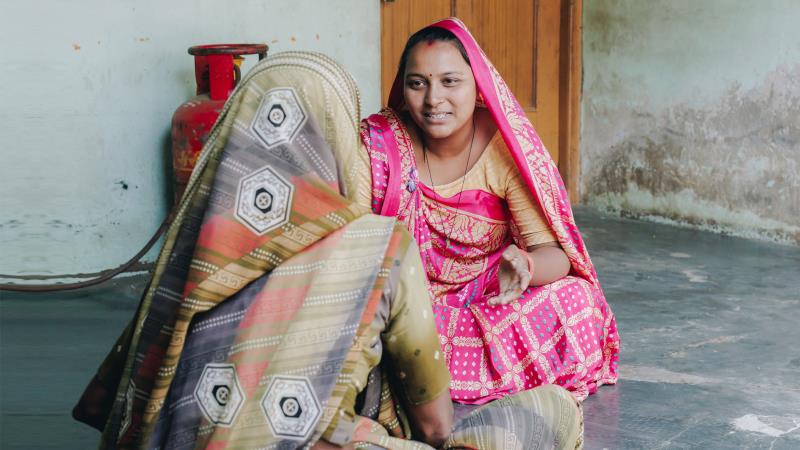
India is facing a significant mental health ‘crisis.’ It’s a phrase that’s been echoed across articles, social media, newspapers, and public discourse, especially as conversations around mental wellbeing gain momentum post-pandemic. But what really is the mental health ‘crisis,’ and how did we get here?
In this article, we unpack the mental health perspective in India and share an example of a community-led mental health intervention that aims to increase access to evidence-based mental health and social care.
The last National Mental Health Survey (2016) tells us that approximately 10.6% of the population experiences common mental health conditions such as anxiety and depression: approximately 90 million people across the country. More strikingly, 72-90% of those people do not receive the mental health care they wish to seek. This is typically called the ‘treatment gap.’ Unfortunately, discourse around the treatment gap has largely been reduced to the issue of a lack of mental health professionals without addressing the psychosocial and physical health care gap.
Yes, we do have a severe shortage of mental health professionals. The same survey from 2016 reports that 11 out of the 12 states assessed had less than 1 psychiatrist for every 100,000 people. Moreover, we have a critical lack of public spending on mental health which further compounds the issue. In the 2024-25 Union Budget, approximately ₹1000 crores, accounting for only 0.003% of the total ₹48.2 lakh crore budget, was allocated to mental health.
More importantly, we must question whether our existing mental health care services are designed to be acceptable, i.e., are people willing to take up the solutions we offer, are they accessible to diverse groups, affordable, and of good quality? Currently, we have a health systems response that is heavily skewed towards curative and treatment focused approaches, with far less investment in building self-care, community-based care along with multi-sectoral preventive and promotive mental health approaches.
Structural and social determinants of mental health
Evidence shows that mental health does not exist in isolation from broader social determinants. According to research, anxiety and depression, referred to as common mental health conditions, are linked to psychosocial and structural factors such as gender, sexuality, caste, income, education, and livelihood security.
For example, we know from research that women are more likely to experience anxiety and depression than men. However, on its own, this statistic does not capture the complex interplay of social and structural factors, such as poverty, unemployment, and discrimination, that shape mental health outcomes. The following vignette offers a glimpse into how these everyday realities can contribute to emotional distress.
Every morning, Meena, a 25-year-old woman in a semi-rural village, wakes up before dawn. She prepares meals for a family of 4, sends her 5-year-old child to school, tends to the needs of her in-laws, manages the household, and works on the farm in the afternoons in the peak summer heat. She left school after Class 8 and has never had a job. Her husband recently lost his job and has begun consuming alcohol. The tension at home is growing, affecting the children, and there is a constant stress around money. Over time, Meena starts experiencing aches and pains, and has trouble sleeping. However, she never thought of seeking support.
Meena’s stressors are linked to her social and structural environment, and therefore not considered mental health issues - and she is not wrong. Historically, mental health has been seen as an individual issue, but it is deeply tied to our social worlds. To truly address mental wellbeing, we need to look at its determinants: the sociocultural, structural, and economic factors that shape mental health every day.
The need for community-led mental health
The World Health Organization offers a useful model to guide how mental health services can be organized. The model posits that most of the mental health support for common mental conditions such as anxiety and depression can come from self-management and community-based, informal networks (such as support from family, friends, and community groups). As people need more specialized care, a layered system of services is designed to step in: starting from primary care and community health services to psychiatric units in general hospitals, and finally, specialist and long-term mental health facilities.
In India, however, we are concentrated on tertiary services alone, especially standalone-mental health facilities that remove people from their community level. Even less severe cases are often treated in specialized clinical settings with a primarily biomedical focus that overlooks sociocultural and economic factors shaping distress.
For mental health services, demand side barriers like low uptake of services, stigma and discrimination around mental health, and supply side gaps such as limited access to specialized services and a shortage of trained providers, make it even more difficult for people to seek help. This underscores the pressing need for self-care and informal community-based care, especially in low-resource areas.
Community-led solutions: The Atmiyata approach
Research indicates that community-based initiatives with lay-health workers or non-specialists can help bridge this large mental health care gap. This raises the question: if current services aren’t reaching those in need, what alternative models can help bridge the gap? Where, and by whom, should care be delivered? And what works in low-resource settings where formal systems often don’t reach? More importantly, are they effective?
To answer some of these questions, the CMHLP developed Atmiyata, meaning empathy and shared compassion, an initiative that uses a community-led approach to make mental health and social care accessible at people’s doorstep, free of cost. By tapping into existing social networks and building local capacity, these approaches make mental health support more accessible and sustainable.
Atmiyata frames mental health as an issue shaped by people’s social and economic realities. The program trains local volunteers called Atmiyata Champions to provide basic psychological support and refer people to formal services when needed.
Specifically, Champions conduct four broad activities. They are trained to identify and provide 4-6 evidence-based counselling sessions to people in distress or those facing anxiety and depression. For more complex mental health conditions, the Champions provide supportive referrals to the nearest and accessible specialized mental health professionals.
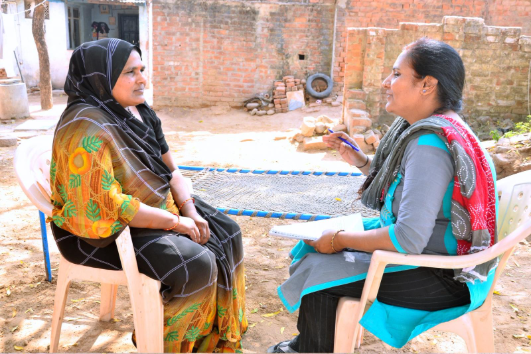
Atmiyata also aims to break the vicious cycle of poverty and mental ill-health. Therefore, Champions also facilitate community members with mental health conditions to access social benefits such as pension schemes. Additionally, the program uses narrowcasting of short films to link social determinants to mental health such as unemployment, domestic violence, and alcohol abuse.
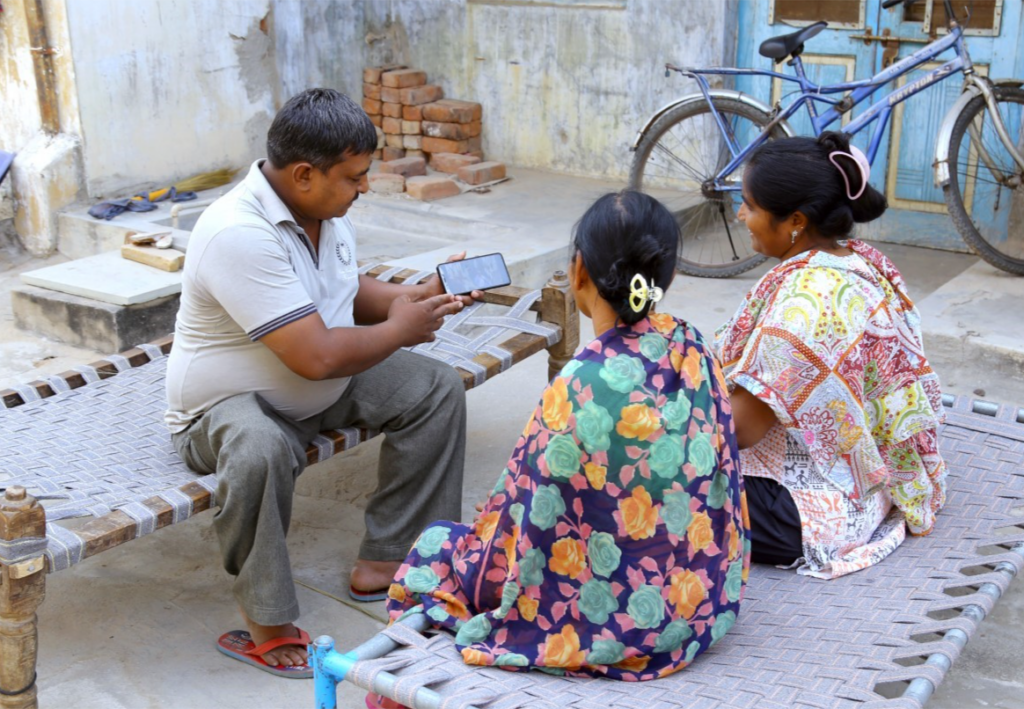
A core tenet of Atmiyata is its emphasis on empathy, trust, and social credibility. Champions create safe and nonjudgmental spaces where individuals can share their feelings openly without being judged. One Champion stated,
“We met a young girl who had lost her leg in an accident and had been bedridden for four years. She had mentally broken down. We supported her to go back to school, helped her get an artificial limb, and watched her slowly regain her confidence. After seeing her transformation, I felt we could help anyone through Atmiyata.”
- Prajapati Vanita Ben (Kukdia village, Sabarkantha district)
By using trained community volunteers who are embedded in the social fabric of their villages, Atmiyata promotes community cohesion, resilience, and community ownership over the program.
Atmiyata’s scale-up: Locally and globally
Since 2015, Atmiyata has scaled from approximately 41 to 2000 villages across 7 states across in India. From Gujarat and Maharashtra, the intervention has grown to Himachal Pradesh, Uttarakhand, Karnataka, Chhattisgarh, Tamil Nadu, and Sikkim. On average, Atmiyata reaches out to 25,000 adults with common mental disorders each year in a rural district of one million people. The program’s expansion across the country reflects its adaptability across diverse social and geographic contexts and its success in delivering care.
Atmiyata has also been recognized by the World Health Organization (WHO) as one of 25 good practices for community outreach mental health services globally. Moreover, it has been featured as a case study in the WHO South-East Asia Region as an example of community-led care in low-resource settings.
The intervention is now being adapted beyond India. Atmiyata is being piloted in East London in partnership with Queen Mary University of London and Newham Council, Newham Community Project. This is a notable example of innovation flowing from the Global South to the Global North, reflecting on the value of community-led care in multicultural high-income contexts as well.
The way forward
The solutions for reducing India’s large mental health care gap lies in community-led mental health that is grounded in local realities. Atmiyata is one such initiative that shows how community approaches grounded in empathy, trust, and social connection can successfully expand access to care. As mental health needs grow in India and around the world, it becomes increasingly clear that we need grassroot models to make care accessible, sustainable, and inclusive for all.
For any further queries and collaboration, please contact us. Info@cmhlp.org
Key takeaways- India faces a large mental health care gap, with most people unable to access support.
- Social factors like poverty, gender roles, and discrimination strongly shape mental well-being.
- Current services rely too much on specialist care, limiting reach in rural areas.
- Atmiyata trains community volunteers to offer counselling and connect people to services.
- The model is scalable, low-cost, and recognised globally for improving access to mental health care.